

The Ultimate Human Endeavor
Standing on the roof of the world demands uncompromising strategy, world-class expertise, and absolute mental focus. Step beyond the ordinary into the most unforgiving environment on Earth to write the most extraordinary story of your Mt Everest Expedition.
We ascend Mt Everest via the historic Southeast Ridge (Nepal)—the iconic route pioneered by Sir Edmund Hillary and Tenzing Norgay Sherpa in 1953. Navigating through the Khumbu Icefall, the Western Cwm, the Lhotse Face, and across the legendary Hillary Step, this proven line offers the ultimate blend of classic high-altitude mountaineering and unmatched expedition support.
The best season to climb Mt Everest is during the Spring, when the weather is stable, calmer winds, mild temperatures, and optimal snow conditions.
Hi On Life Adventures welcomes you to join our Mt Everest Expedition via the Classic South East ridge!
Mt Everest Expedition- via the Classic Southeast Ridge
Mt Everest, standing at 8848 meters above sea level, is the highest point on Earth. It is called Sagarmatha in Nepal and Chomolungma in Tibet. Mt Everest is located inside Sagarmatha National Park, listed in the UNESCO World Heritage. Surrounded by gigantic peaks, and dramatic glaciers, this spectacular region is home to the legendary Sherpa people, who are the back bone of a successful Mt Everest Expedition.
Discovery & Legacy
In 1852, the Great Trigonometrical Survey identified Peak XV as Earth’s highest mountain, later named after Sir George Everest. Mt Everest was first summited on May 29, 1953, by Sir Edmund Hillary and Tenzing Norgay Sherpa. Mt Everest has seen over 10,000 ascents while remaining an unforgiving peak that demands absolute respect.
Mt Everest Expedition: The Ultimate Summit Blueprint
A successful summit is built on precise planning, a smart approach, and relentless attention to detail.
Smart Logistics
Direct Helicopter Flights to Lukla: Avoid fixed-wing weather delays with guaranteed helicopter transfers straight into the valley.
Luxury, Comfort & Base Camp Life
Our Base Camp infrastructure sets the industry standard for high-altitude comfort, technology, and health support.
The Common Lounge
At the heart of Base Camp sits our common lounge tent. Fully carpeted and heated, equiped with a coffee machine, this serve as our main social hub to watch movies, work, read, or relax.
Power & Connectivity
Powered by quiet solar arrays with backup generators, our camp features 110V charging stations, a high-gain VHF radio station linked to high camps (C2 to South Col), and wireless internet connectivity.
Medical Care
You get medical checkups and care through our direct access to the Himalayan Rescue Association (HRA) doctors right at Base Camp.
High-Altitude Nutrition
High altitude drains energy and dampens appetites, making proper nutrition one of the most critical factors on an 8,000-meter expedition. At Base Camp and Camp 2, our dedicated cook teams bake fresh bread, cakes, and rolls daily—bringing a welcome touch of comfort to the glacier. Supported by regular deliveries of fresh meats, crisp vegetables, and seasonal fruits, we ensure your body stays nourished with wholesome, high-calorie meals. We cater fully to vegan, vegetarian, and gluten-free diets, and maintain a dedicated “high-camp food supply tent” so you can hand-pick your favorite comfort snacks for the summit push.
Weather & Logistics Tracking
Continuous weather forecasting updates coordinated directly between Base Camp and our Kathmandu office
Acclimatization: The 4-Phase Expedition Strategy
To prepare your body for extreme altitude, we follow a carefully calculated rotation strategy—climbing high and sleeping low to build natural endurance
Phase 1: Acclimatization climb to Lobuche Peak 6119m
Before starting our Mount Everest climb, we climb nearby Lobuche East (6,119 m) for acclimatization. This allows your body to adapt to high altitude safely while eliminating an extra, unnecessary pass through the Khumbu Icefall to Camp 1.
Phase 2: Acclimatization rotation to Camp 2
Focused to balance technical acclimatization with safety, this phase guides climbers through the Khumbu Icefall to establish Camp 2 in the Western Cwm. By incorporating a planned rest day and an acclimatization push to 6,700 meters at the base of the Lhotse Face, we maximize natural acclimatization, concluding with a full descent to Base Camp to ensure complete physical recovery.
Phase 3: Acclimatization rotation to Camp 3
Capitalizing on your initial acclimatization, the team bypasses Camp 1 to move directly from Base Camp to Camp 2 (6,400 m). From there, climbers ascend the steep ice of the Lhotse Face to spend a critical overnight at Camp 3 (7,200 m). Returning to Base Camp allows for deep physical recovery while our leadership closely monitors weather forecasts to pinpoint the safest summit window.
Phase 4: Summit Push
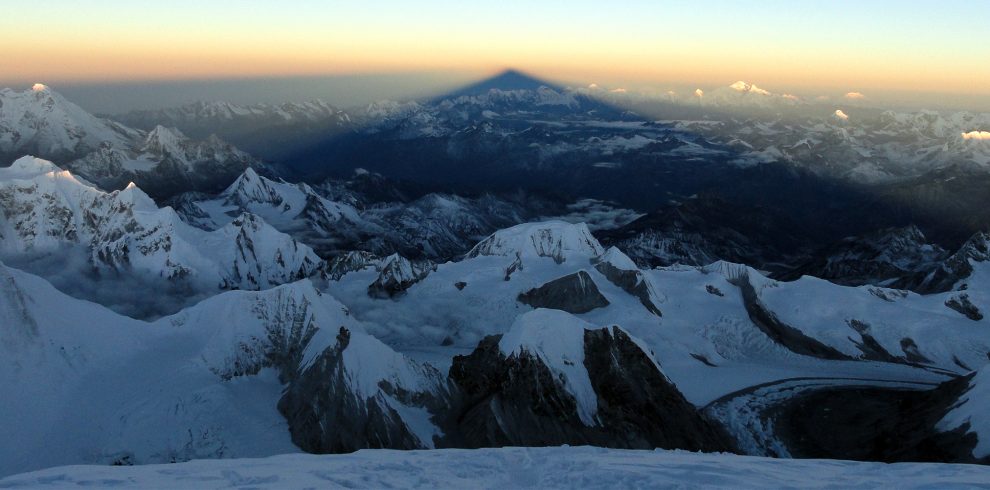
When the weather window opens, the team executes the final summit plan, moving swiftly from Base Camp through Camp 2 and up the Lhotse Face to Camp 3. Crossing into the high-altitude realm, climbers reach the South Col (Camp 4 at 7,925 m) to rest, hydrate, and prepare for a midnight departure. Pushing through the night via the Balcony, South Summit, and Hillary Step, you reach the top of the world at 8,848 meters at sunrise before making a carefully managed descent back down through the high camps and the Khumbu Icefall to celebrate safely at Base Camp.
Tailored Summit Tiers: Oxygen protocol and Sherpa Client ratio
Hi On Life Adventures offer two distinct climbing packages for Mt. Everest.
1. Classic Everest Climb (1:1 Nepalese Guide)
Our flagship Everest program
This tier offers experienced high-altitude climbers the ideal blend of top class logistics and personalized pacing.
Guide Ratio: You will be supported by an assigned 1-on-1 Nepalese guide for every rotation under the active supervision of our Expedition Leader.
Oxygen Strategy: Supplemental climbing oxygen supplied at 3 Liters Per Minute (LPM) starting from Camp 2 through the summit push.
2. Premium Everest Climb (1:2 Nepalese Guides + Extra Oxygen)
Enhanced Support & Increased Oxygen Flow
Designed for climbers seeking an elevated tier of physical backing and pacing independence on the mountain, our revamped Premium Program delivers maximum support without sacrificing personalized schedule flexibility.
Guide Ratio: You will be supported by an assigned with 2:1 dedicated guide support (two personal guides assigned to one climber) for all high-mountain rotations and summit pushes.
Oxygen Strategy: Supplemental climbing oxygen supplied at 3 Liters Per Minute (LPM) starting from Camp 2 and a 4 Liters Per Minute (LPM) on Summit Day for enhanced safety, warmth, and physical output in the Death Zone.
Emergency Evacuation & High-Altitude Helicopter Logistics
Safety in the Death Zone requires zero compromise and clear, tested response plans
Gamow bag & Rescue Oxygen Systems Allocation
Gamow Bag (Hyperbaric Chamber Bags) and extra flow Oxygen bottles are cached at Camp 2 (6,400 m) to lower simulated pressure by up to 1,000 meters during severe altitude emergencies (HAPE/HACE).
Helicopter Evacuation Logistics
While modern high-altitude helicopters can technically reach extreme elevations, the ultra-thin air above 6,000 meters severely limits their lift and hovering ability. In practice, Everest Base Camp (5,364 m) and Camp 2 (6,400 m) serve as the primary helicopter pickup points. This means if an issue arises higher up, our strong Sherpa rescue team must first guide or assist the climber down the Lhotse Face or Khumbu Icefall. Helicopter extractions from Camp 3 or the South Col remain extremely rare, high-risk operations reserved strictly for life-threatening emergencies when ground descent simply isn’t an option.
It must be noted that Helicopter Evacuations are limited to daylight hours and clear, low-wind weather windows.
Mt Everest Expedition Insurance
Comprehensive high-altitude rescue insurance (covering search and rescue up to 9,000 m, including helicopter extraction and medical repatriation) is a mandatory prerequisite for every climber before stepping foot on the mountain.
Preparation & Physical Conditioning
Mt Everest Expedition is graded IV-E. Please read about our grading system
Mount Everest expedition requires rigorous physical and psychological preparation. Prior high-altitude experience on a 7,000-meter peak is strongly recommended to master technical rope skills, crampon movement, and cold-weather management.
Highlights of the services
- Climb the Mountain, the Highest Point on Earth (8,848.86 m)
- The Ultimate Test of Human Endurance & Mental Grit
- Experiencing the Legendary Khumbu Icefall & Southeast Ridge
- Becoming Part of an Elite Mountaineering Legacy